Falador Massacre Explained: How a Bug Made History

Why this incident still matters to RuneScape and RSPS
Most RuneScape controversies fade because they are social drama, not structural events. The Falador Massacre is different because it was not “a player being toxic” or “a clan going too far.” It was a moment where the game’s rules collapsed in public, in the most recognizable city in the entire world, and thousands of players witnessed the same terrifying truth at once: safety was not guaranteed by location, it was guaranteed by code.
That distinction is why the massacre remains legendary. It was not just shocking. It was instructive. It showed how a single edge case can turn an MMO into something it was never meant to be, and it forced Jagex to redesign assumptions that most players did not even realize existed.
For RSPS, it also became a cultural blueprint. The scene references it constantly, not because it was “cool,” but because it represents the ultimate fear of any online world: one exploit turning trust into panic.
What actually happened in Falador
The short version is simple. Players were killed in Falador in situations where PvP should not have been possible.
The long version explains why the event felt surreal.
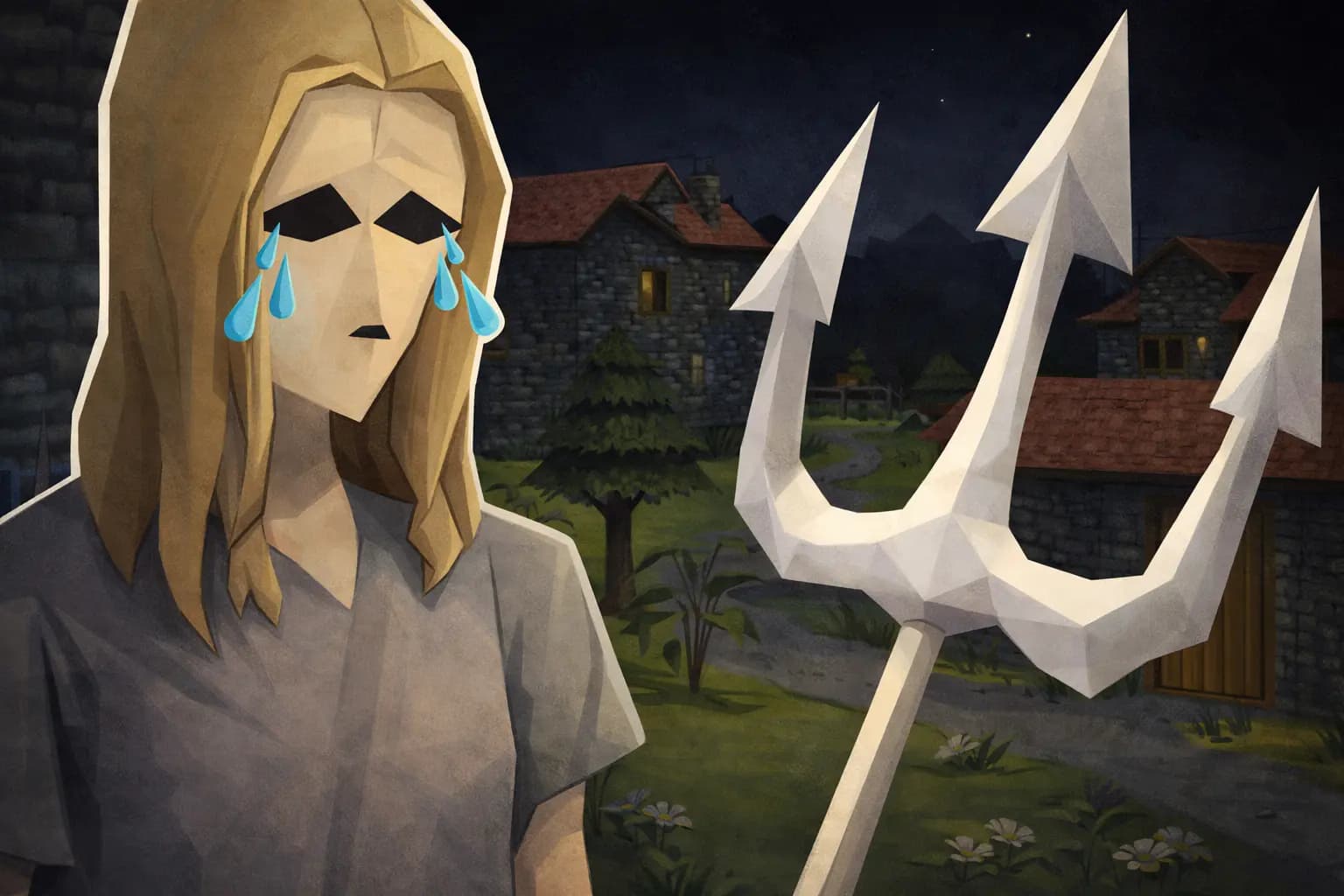
People were not lining up for a duel in the Wilderness. They were standing near banks, walking through streets, chatting, trading, and watching random chaos unfold while characters dropped dead around them. A small number of attackers appeared able to damage and kill players in the open city. In a game that trained you for years to treat Falador as a safe zone, that reversal hit like a horror scene.
It also spread fast because Falador concentrates players. News travels faster in social hubs, and the massacre happened in a place designed to be crowded. The event did not need advertising. The city itself amplified it.
The bug that made it possible
The exploit is often explained loosely as “a house party bug,” but the real importance is the boundary it broke.
Player Owned Houses existed in their own controlled environment, and that environment was designed to have special rules. Combat states, movement, and death behavior inside a house were not supposed to leak into the normal world. The massacre happened because the game accidentally allowed the wrong state to persist after leaving a house environment.
Instead of the player cleanly returning to normal rule sets after exiting, certain combat enabled conditions continued in the live world. That created a nightmare scenario where a player could behave as if they were still in a context where attacking was allowed, while standing in a city where attacking should have been impossible.
This is why the massacre is remembered as more than griefing. It was effectively a temporary rewrite of the rules of reality, caused by a state transition failure.
Why players could not defend themselves
In normal PvP zones, the game gives you mental warnings, visual framing, and social expectations. Even if you lose, you accept the premise that you entered danger.
In Falador, that mental model collapsed. Many players did not have defensive gear on, did not have food, and did not even understand what was happening until they were already dead. Even worse, the chaos itself made it harder to interpret what was real. When crowds panic, players misclick, path awkwardly, or freeze trying to read chat.
The massacre leveraged the most underappreciated weakness in any MMO: players are slow to adapt when the rules change without announcement. A large percentage of victims were not “outplayed.” They were simply trapped inside a broken expectation.
Why Falador was the perfect stage for maximum impact
Falador is not just a city. It is a symbol of safety, structure, and mid game routine. It has banks, paths, and predictable rhythms. When violence happens in the Wilderness, it is normal. When violence happens in Falador, it feels like betrayal.
That is why the same exploit in a remote area would not have become history. Falador ensured high visibility, mass clustering, and constant new arrivals. As players heard rumors, they teleported in to watch, which increased the pool of potential victims and witnesses.
In other words, the massacre scaled because it exploited the social architecture of the game, not just a code flaw.
The social psychology of a “safe zone collapse”
The most important part of the Falador Massacre is not the kill count or the name attached to it. The most important part is what it did to player psychology in real time.
When a safe zone fails publicly, players immediately start asking questions that go beyond that one moment:
Is any place actually safe.
Is my bank value safe.
Is my time investment safe.
Is the game stable.
If this can happen, what else can happen.
That is how a single incident turns into a long shadow. Even after the bug was fixed, the memory remained because it created a permanent new idea in the community: the map is not a guarantee, only the current patch is.
The immediate response and the long term design consequences
After the incident, the correct priority was not punishment. The priority was restoring trust and preventing recurrence. The world had experienced a public integrity failure, and that demands more than a hotfix.
Events like this typically lead to multiple layers of response:
A direct fix to the specific exploit.
A review of related transitions and state persistence risks.
Hardening of rules that should never leak between environments.
Stricter handling of abnormal combat states.
Changes to how and where certain teleports and interactions can occur during edge cases.
Even if players only saw the surface level response, the deeper impact is that the incident forced the game to treat state boundaries as sacred. In a stable MMO, the rules that define safety must be enforced like walls, not guidelines.
Why the Falador Massacre became a permanent reference point
Many infamous moments in online games become jokes. The Falador Massacre became a reference point because it demonstrates a universal truth about multiplayer worlds.
Complex systems do not fail in obvious ways. They fail at the seams.
The seam here was the boundary between a specialized instanced environment and the shared world. If that seam is imperfect, you can get behavior that feels impossible to players because it violates the basic contract they rely on to navigate risk.
This is also why the story survives across generations. Even players who were not there understand it instantly, because every MMO player intuitively fears the moment where “safe” stops meaning safe.
What the massacre teaches RSPS projects specifically
RSPS servers often underestimate how fragile trust is, especially when players already believe private servers are temporary by nature. In that environment, an incident that resembles the Falador Massacre is not just a bug. It is a reputation ending event.
The lessons translate directly:
State transitions must be audited as seriously as combat formulas.
Instanced systems must never leak privileged states into public regions.
Fail closed is better than fail open when safety is involved.
When safety breaks, players assume the server is amateur even if everything else is good.
It also highlights why serious projects invest in protocol discipline and validation. Many of the most destructive exploits are not clever combat tricks. They are state integrity failures that let players do something the world never intended to allow.
The uncomfortable truth about why people still romanticize it
Some parts of the community treat the massacre like a mythic highlight, because chaos is entertaining when you are not the one losing items. But that romantic framing misses the real story.
The real story is that an MMO’s credibility can be shattered in minutes.
The Falador Massacre is famous because it was dramatic, but it is important because it exposed a vulnerability class that every online world must defend against: unintended rule portability.
That is why it still gets cited, still gets compared, and still gets used as shorthand for catastrophic failure.
What makes a “Falador Massacre” possible in any modern RSPS today
The exact exploit is history, but the pattern is timeless.
A massacre event becomes possible when all of these conditions align:
A boundary exists between two rule sets.
A state can persist across that boundary.
The server fails to sanitize or reset the state on exit.
The public world accepts actions it should reject.
Visibility is high enough to spread panic and attract crowds.
If you want to understand why the Falador Massacre remains the most referenced incident in RuneScape history, it is because it perfectly matches that pattern, and the pattern is still relevant.
Why this story will never disappear from the RSPS scene
RSPS is a culture built around altered rules. That makes it unusually sensitive to moments where rules break unintentionally, because the difference between “custom design” and “uncontrolled exploit” is the difference between a playable world and a collapsing one.
The Falador Massacre endures because it is the clearest example of uncontrolled rule breakage ever seen in a RuneScape world. It is the moment the map lied, the city lied, and the game itself briefly stopped behaving like a contract and started behaving like an accident.
That is what history looks like in an online world.
Find Your Next Server
Looking for a new RSPS to play? Browse our RSPS List to discover the best private servers, compare features, and find the perfect community for your playstyle.
More Articles You Might Enjoy
 RSPS
RSPSFrom Player to Developer: How RSPS Builds Game Devs
Discover how RSPS communities turn players into future game developers by teaching real skills like coding, systems design, teamwork, and problem solving.
December 28, 2025